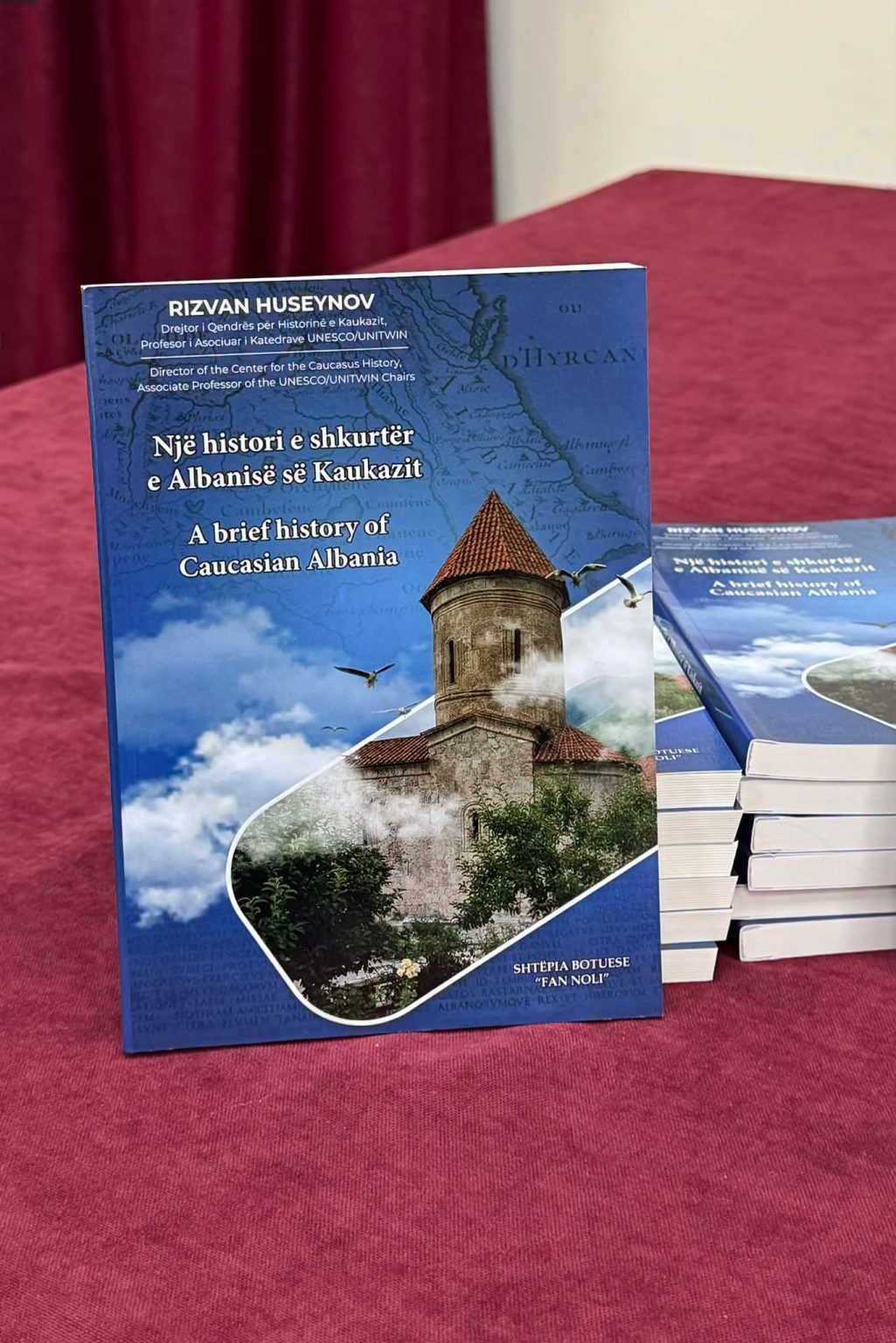
TIRANA, October 6 /ATA/ – The history, culture and heritage of Caucasian Albania took center stage at an academic event held today at the Academy of Sciences of Albania, featuring presentation of the book *A Brief History of Caucasian Albania* by Azerbaijani historian Rizvan Huseynov.
The event was organized by the Academy of Sciences of Albania in cooperation with the Embassy of the Republic of Azerbaijan in Albania. Attendees included President of the Academy, Academician Skënder Gjinushi; Ambassador of Azerbaijan to Albania Anar Huseynov; the book’s author—who also serves as Director of the Center for the History of the Caucasus—Rizvan Huseynov; as well as scholars and representatives of the Udi community.
The Scientific Secretary of the Academy of Sciences, Academician Anila Hoda, hailed the event as a contribution to enrich the scholarly and cultural dialogue between Albania and Azerbaijan. She emphasized that the publication of the work in Albanian offers scholars and readers the opportunity to gain a closer understanding of the history and cultural heritage of Caucasian Albania, including the region’s ancient history, art, architecture, religious life and Christian heritage.
Hoda highlighted the importance of expanding cooperation between the two academies, noting that the memorandum of cooperation paves the way for joint projects, scholar exchanges and academic publications.
Ambassador of Azerbaijan to Albania Anar Huseynov commended the event held at the Academy of Sciences, underscoring the importance of studying and promoting the history of Caucasian Albania and its historical, cultural, religious and architectural heritage.
He emphasized the importance of disseminating accurate information regarding this history and noted that Huseynov’s book offers an opportunity for a deeper understanding of this heritage and encourages further academic research. During the event, Academician Gëzim Hoxha, Head of the Section of Social and Albanological Sciences, delivered a lecture entitled “An Overview of the History of Caucasian Albania,” in which he praised the work as a contribution to understanding the history, culture, and religious traditions of the region.
Hoxha highlighted the importance of interdisciplinary approaches—integrating history, archaeology, philology and epigraphy—as well as the use of diverse ancient and medieval sources to reconstruct the history of Caucasian Albania.
Author Rizvan Huseynov presented the history of the Albanian Apostolic Church, the development of the Albanian script and culture and the region’s art, architecture and significant monuments.
In his presentation, he focused on the Church of St Elisha in the village of Kish, as well as the monastic complexes of Gandzasar, Khudavank and Agoghlan. Huseynov emphasized the interdisciplinary nature of the work, which draws upon historical sources, medieval chronicles and archaeological, epigraphic and linguistic evidence. The book also devotes significant attention to the history of the Albanian heritage and identity across various historical periods, as well as the role of the Udi community in preserving the Christian tradition of Caucasian Albania.
At the conclusion of the event, Robert Mobili, head of the Udi-Albanian Christian Community in Azerbaijan, spoke about the nearly two-thousand-year history of Christianity in the region and the historical and archaeological evidence regarding the development of ecclesiastical organization.
He also highlighted the period following Azerbaijan’s independence, which saw the restoration of churches and places of worship and the revival of the Udi community’s religious life, describing this process as an example of interfaith coexistence.
The event was hailed as an opportunity to strengthen academic and cultural cooperation between Albania and Azerbaijan and to encourage further research into the history and heritage of Caucasian Albania.
/e.xh/j.p/p.s./