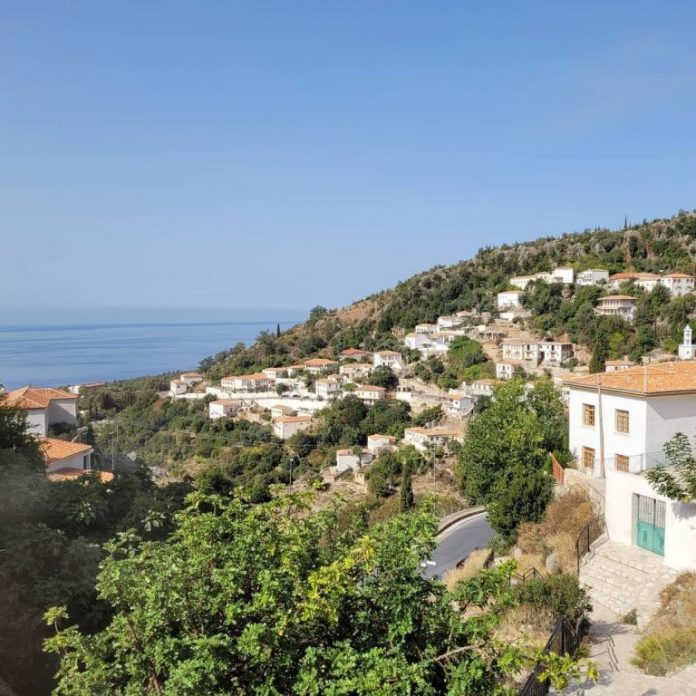
TIRANA, Oct 1 /ATA/ The historic center of Vuno, a picturesque village on the Albanian Riviera, will be protected through its designation as an immovable cultural heritage site. A government decision defines the protected area and approves a plan for the preservation, protection, and administration of the historic center and its surrounding area.
According to the decision, Vuno’s Historic Center is divided into two zones. Zone I includes the buildings on both sides of the national road, while Zone II covers the southern part of the village, including the Church of St. Spyridon, the school, and the Church of St. Michael.
The protection measures cover not only historic buildings, but also traditional homes, religious sites, green spaces, squares, the landscape, and the characteristic cobblestone streets.
The decision prohibits new construction within the Historic Center, except for interventions envisaged for the restoration, reconstruction, and rehabilitation of existing structures. Restoration and reconstruction must preserve Vuno’s traditional character, including its materials, colors, architectural typology, volume, original elements, and traditional construction techniques.
The decision also sets out specific requirements for traditional roofing, stipulating that four-pitched roofs must be preserved, with a 25–30-degree slope and locally produced red tiles, in keeping with the area’s cultural landscape.
New construction will also be permitted within the protected zone, provided it is compatible with the area’s traditional architecture and landscape. New buildings will be limited to two floors and a maximum height of 6.5 meters to the roofline, while also respecting the average height of surrounding structures.
The construction of industrial structures and quarries is prohibited both within the Historic Center and the protected zone. The Historic Center also prohibits structures that may pose a risk, as well as sports facilities exceeding 220 square meters.
Interventions on Category I and II Cultural Monuments are limited to maintenance, conservation, restoration, and adaptive reuse, provided that these interventions do not compromise their heritage values.
Restoration and intervention projects must be designed by licensed institutions or professionals and reviewed and approved by the National Council of Material Cultural Heritage.
The implementation of this decision will be overseen by the Municipality of Himara, the Ministry of Tourism, Culture and Sports, and the Ministry of Infrastructure and Energy.
/j.p/r.e/sm/