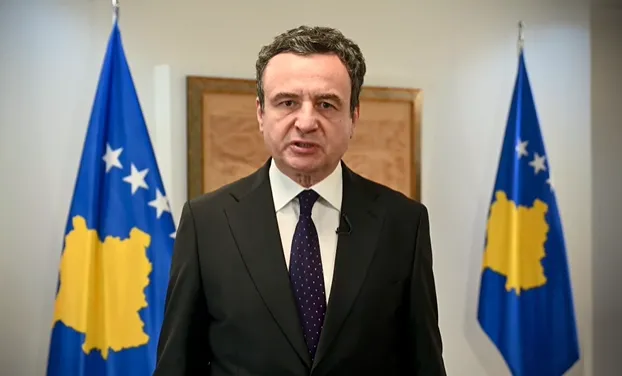
PRISTINA, Sept 16 /ATA/ Kosovo’s Prime Minister Albin Kurti condemned the convictions of Hashim Thaçi, Kadri Veseli, Rexhep Selimi and Jakup Krasniqi, calling them an “unacceptable injustice.”
“Finding them guilty and handing down such a severe sentence for four former leaders of the Kosovo Liberation Army is an unacceptable injustice, a grave and damaging punishment,” Kurti said in his reaction.
Kurti also opposed the wording that the judgment was delivered “in the name of the people of Kosovo,” arguing that this “empty formula must not be confused with the will of the people.” He called for the first‑instance ruling to be overturned on appeal.
Kurti insisted that this judgment must be overturned on appeal and as soon as possible. He also expressed solidarity with the families of the four former Kosovo Liberation Army leaders and their fellow fighters.
Following is Premier Kurti’s reaction in full:
“The declaration of guilt and such a severe sentence for four former leaders of the Kosovo Liberation Army — Hashim Thaçi, Kadri Veseli, Rexhep Selimi and Jakup Krasniqi — is an unacceptable injustice, a grave and damaging punishment. The judgment may have been formally pronounced in the name of the people of Kosovo, but this empty formula must not be confused with the will of the people.”
Kurti declared that “this judgment must be amended and corrected at the appellate stage, and as soon as possible.” He added that, in these difficult moments, the government stands alongside the families of the former Kosovo Liberation Army leaders and all their fellow freedom fighters.
“As we know, everything began on 15 April 2008 with the accusations in the Council of Europe from Russian MP Konstantin Kosachev and Serbian MP Milos Alligrudić, but we must ensure that nothing has ended today, 16 September 2026. None of the exaggerated and senseless claims on which the establishment of the Specialist Chambers was justified — starting with the ‘Yellow House’ and alleged organ trafficking — could be substantiated by the Prosecutor, due to the lack of evidence.”
“Today’s judgment of the Specialist Chambers has dismissed the gravest allegation remaining in the indictment — that the KLA carried out a widespread and systematic attack against a civilian population. It was also made clear that this process was not a trial of the legitimacy or purity of the KLA’s war. Nor was even the most basic condition for crimes against humanity established. The convictions relate instead to specific charges of war crimes, including the torture of individuals deemed collaborators with the Serbian regime. These findings are unjust, but are final and will be subject to review on appeal.
“The injustice of the Prosecutor’s charges has been noted not only within Kosovo but also abroad. International figures who had witnessed the conflict first‑hand testified before the Court about the character of the liberation war and of the KLA. They described the KLA as a response to decades of oppression of Albanians and rejected the claim that it was responsible for ethnic cleansing; they also challenged the thesis of a centralised command controlling every action on the ground. These testimonies came from individuals who observed the war from positions of direct international responsibility and who attested to its liberating nature. Their detailed and reasoned criticisms underline that today’s judgment rests on fundamentally flawed foundations, both historically and legally. As we have done since the outset of this process, the Government will continue, with all means at its disposal, to support the accused in the appeal proceedings, where we expect a full correction of this injustice.”
“This judgment cannot be read outside the history in which the KLA was born. The KLA was not the choice of a people seeking war, but the response of a people who, oppressed and threatened in their very existence, sought freedom. The Albanian people of Kosovo endured the removal of autonomy, exclusion from institutions, dismissal from workplaces, schools and universities, imprisonment, torture and killings. Later came massacres, the burning of settlements, the mass expulsion of hundreds of thousands from their homes and genocide. This suffering was not a random backdrop to the war, but the reality that made resistance a matter of survival for a people.”
“No human suffering should ever be denied or diminished. Yet it would be equally unjust for findings on certain actions to be transformed into an indictment against the KLA and a trial of the liberation war itself. The Kosovo Liberation Army was born as a response to the oppression of a genocidal regime and fought for the liberation of Kosovo. That is its political and historical character, and neither the selective architecture of a judicial mechanism nor any of its judgments can undo it. “For a century and a half, from the mid‑19th century to the closing years of the 20th, Serbia’s state, political, academic and pseudo‑scientific institutions produced 24 programmes for the extermination of Albanians.”
“The Specialist Chambers were created with a special mandate, yet their mandate and activity concentrated justice solely on one side of the war. When only members of a single ethnicity find themselves in the dock, while the state apparatus that carried out massacres, expulsions and genocidal crimes remains outside jurisdiction, the image of one‑sided justice inevitably emerges. This perception has been deepened by the lack of transparency in a process whose significant parts have been conducted away from public view and scrutiny.”
“A mechanism in which criminal responsibility is concentrated solely on members of one people or ethnic community, while the genocidal crimes of the other side remain beyond effective prosecution, raises serious concerns about equality before the law, objective impartiality and the legitimacy of the institution itself. Selective justice on ethnic grounds runs counter to the fundamental principle that justice must not only be impartial, but must also be perceived as such.”
“Kosovo will continue to support Hashim Thaçi, Kadri Veseli, Rexhep Selimi and Jakup Krasniqi in the appeal proceedings, ensuring their defence is full, dignified and institutional. This is both a responsibility towards our citizens and an expression of confidence in the right to challenge a judgment that is not yet final.”
“Today, specific charges and actions were judged; the reason why the KLA was born was not tried, nor can it be condemned or tarnished. For when the homeland could no longer endure tyrants, it called upon liberators — and their name was the Kosovo Liberation Army.”
/sm/