TIRANA, Aug 16 /ATA/ We stop along the road leading to Lurë National Park, beside a stream running across the surrounding fields. Tall walnut trees, their nuts still green, stand alongside apple and plum trees, their branches heavy with an abundance of fruit.
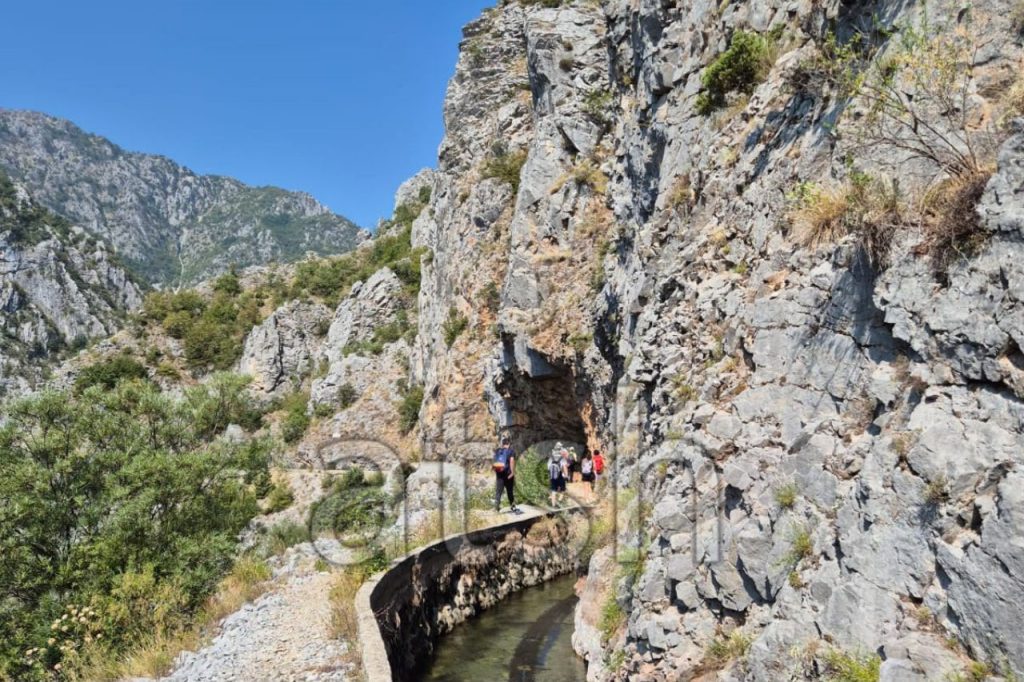
A gentle uphill walk leads to the canal’s first station. The path is narrow, hugging steep slopes, yet wide enough to walk along while keeping your footing.
Along the trail, the Seta Canal runs through a concrete channel, carrying clear water from the Seta Canyon below the mountain to irrigate the surrounding farmland.
The canal cuts across the slopes of the Gjallica e Lurës, as the mountain is known by local residents, a landscape of sharp rocky ridges and deep ravines carved by the river over centuries.
The farther we make our way along the mountainside, the more spectacular the canyon slopes below become. In some sections, we have to rely on ropes attached to steel cables to make the passage safely.
Few people from outside Dibër know much about the Seta Canal. Engineers may have studied it in their textbooks, but to us, the structure seemed both remarkable and almost unbelievable, especially knowing that it was built through voluntary labour by local residents.
Today, the canal remains a reminder of the past while also serving as a tourist attraction for adventurous visitors undeterred by heights.
The path along the canal covers three kilometres, while the descent into the canyon and the return journey through it extend the route to more than 12 kilometres.
The canal runs around 300 metres above the canyon, following steep, sheer rock faces. In some places, it cuts through the rock and passes beneath it, emerging again on the other side. The water is clear and cold, and the canal is deep enough for swimming in some sections.
But the journey to the area was long and arduous until the completion of the Arbër Road, which has since helped turn it into a popular weekend destination.
The Seta Canyon, meanwhile, offers sweeping views of towering walls above the river, which has little water at this time of year. In some sections, the riverbed is almost entirely exposed, covered in gravel.
For now, exploring the entire trail will have to wait for another time. The return journey is again along the Seta Canal, with time for a dip in its waters in the small pools formed where the canal passes beneath the rock.
It is remarkable to think how perfectly the canal was built, yet it stands today as silent evidence of an effort that time has largely erased.
Local residents recount stories passed down by older generations of people tying simple ropes around their waists and hanging over the precipice for hours, holding a chisel in one hand and striking the rock with the other.
Just a little farther on, in the village of Sinë, is the museum dedicated to the birthplace of the Kastrioti family. Along the way, signs point visitors towards Skanderbeg’s Rock and the caves where he is said to have hidden with his army.
The Seta Canyon has its own legends too, including stories of hidden caves containing treasures left behind by outlaws, as well as tales of mountain spirits said to guard the springs.
The Sopanikë restaurant has equipped the trail with ropes and wooden steps for visitors, while tables are scattered across the waterfall area, surrounded by moss and tall trees. The waterfall cascades into the river, forming a series of small pools along its course, and springs directly from the slopes of a karst cave that is also open for exploration.