20.9 C
Tirana
18-10-26
Home Flash News

Rama says protests aim to perpetuate conflict rather than resolve issues

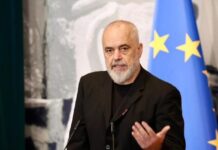
TIRANA, June 20 /ATA/ Prime Minister Edi Rama told a meeting of the Socialist Party parliamentary group that parts of public and political debate are increasingly shaped by dynamics that encourage confrontation and persistent opposition, regardless of the issue at hand.

He said that complaint and criticism are a normal and necessary feature of a democratic society, but cautioned that difficulties emerge when they become a fixed part of political identity.

Rama said that complaints are a normal part of public life and that criticism is essential, describing it as “the engine of progress”.

However, he warned that problems arise when criticism ceases to be a means to an end and instead becomes an identity. In such cases, he said, individuals no longer seek solutions to problems but rather the continuation of them, so that new issues can constantly be found once existing ones are resolved.

He said that, in these cases, the focus shifts away from any particular issue and instead becomes the continuation of confrontation itself.

“A part of political movements is not based on what those involved want to build, but on what they want to remain unchanged,” he said. “One day it is a project, the next a law, then a minister, then an ambassador. There is no clear objective; what matters is that the engine keeps running and the noise never stops.”

The Prime Minister underlined that criticism remains essential to democracy and to improving governance, but said that “the problem arises when the object of criticism becomes less important than the need to criticise itself, and when a solution becomes a problem for the cause, because a resolved problem no longer generates frustration”

“Democratic societies live on criticism. The problem is when the object of criticism becomes less important than the need to criticise itself, and when a solution becomes a problem for the cause because it no longer produces anger, and this is concrete. From the second day of a protest, they do not want to listen, they do not want to talk, there is no negotiation,” he said.

Rama said the phenomenon is not unique to Albania, but a global political trend which, in his view, has been amplified by the way social media platforms operate.

“Anyone who thinks that politics can be done—or is done solely—through likes and followers is mistaken,” he said. “With likes, you are serving some of the biggest oligarchs on the planet, who become richer every day through algorithms. The algorithm does not reward calm, because calm is its enemy. It does not reward nuance or reason; it rewards conflict, outrage and the intimidation of others, because intimidation generates clicks, clicks generate time, and time generates money.”

Rama said that protests and public debate are increasingly being shaped and repurposed for social media consumption.

“For the first time in history, the attention economy has become a political economy: the more anger there is, the more visibility, influence and power it generates, in the hands of those who serve algorithmic systems,” he said. “This is why today protests do not only take place in squares; they need the square simply as a backdrop for a crowd performing for the algorithm. Even the square becomes a television studio—a place to film content that feeds the algorithm and justifies it.”

He added that this, in his view, defines the struggle of the present era. “It has nothing to do with left or right, but with conflict itself. Whoever seeks likes and followers through anger is working against their own children.”

/e.xh/ /a.g/sm/

Previous articleMinister Salla says locust control measures contain spread in agricultural regions, situation stable
Next articleProtest against Zvërnec investment enters 21st day, joined by diaspora supporters