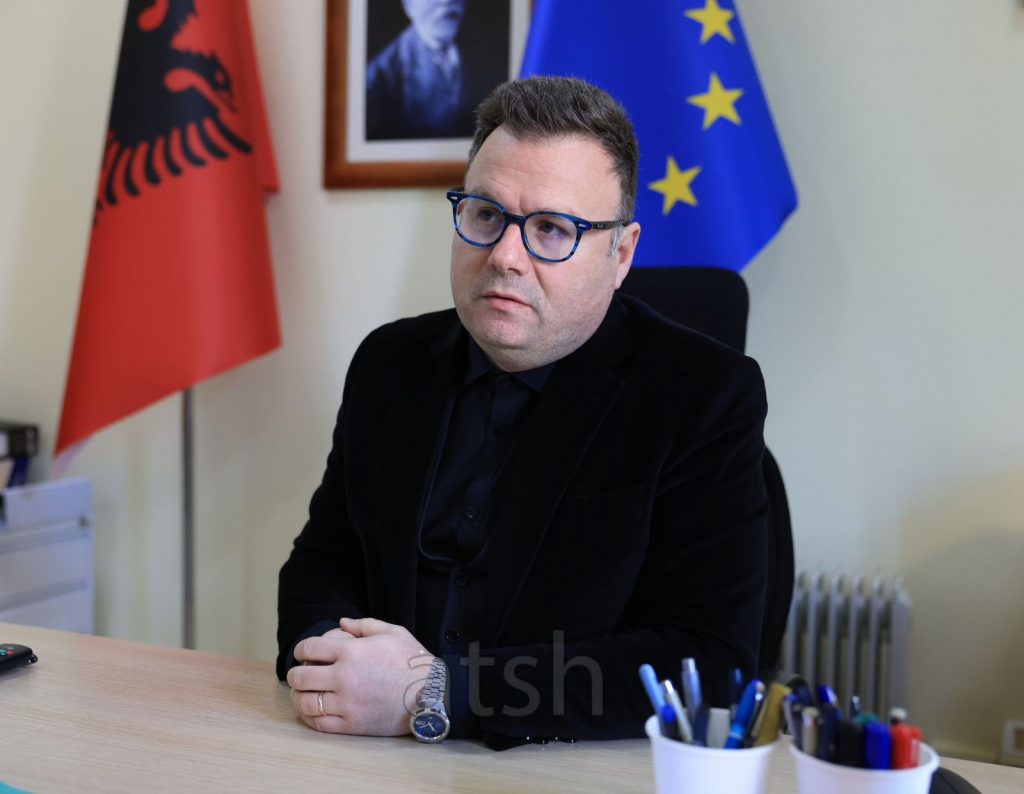
TIRANA, Jan 25 /ATA/ Deputy Minister of Agriculture and Rural Development, Fatmir Guri, stated that food safety remains one of the most challenging chapters in Albania’s process of EU accession.
In an interview with the Albanian Telegraphic Agency, Guri explained that Chapters 11, 12, and 13—which cover agriculture and rural development, food safety, and fisheries—were the last to be opened in the negotiations with the EU.
“The 2026 National Scheme will serve as a tool for alignment with the EU, including support measures and legal requirements for farmers and livestock breeders. In 2026, this process will be voluntary, while in 2027 it will become mandatory, with the aim that by 2030 Albanian farmers will find in the EU the same conditions that have been gradually established for them through the national scheme,” Guri said.
He emphasized the importance of standardizing food safety within farms and livestock operations. “These measures will enhance food safety at the farm level, including the use of pesticides and the traceability of products from the farm to the final consumer. An agronomist will oversee the use of these products and sign the farmer’s logbook, thereby creating an unbroken traceability chain,” he explained.
Concerning Chapter 12 on food safety, Guri stressed that a significant number of bylaws must be drafted and implemented, highlighting the European Union’s “CC Food Safety” project, valued at €13.5 million, which seeks to categorize food operators and bring them into alignment with EU standards.
The Deputy Minister added that this process will also receive financial support from the Albanian Insurance Bank (BShS), the sovereign credit, and the Development Bank, in order to ensure the implementation of EU standards in food and livestock production.
“The 2026 National Scheme will require farmers and livestock breeders not only to produce, but to produce in accordance with stipulations aligned with EU standards, thereby creating a safe and traceable food product chain,” Guri concluded.
Guri: Assessment of rainfall damage is in full swing, focus on problematic embankments
Fatmir Guri, Deputy Minister of Agriculture and Rural Development, reported that 87 experts from the ministry have been deployed to verify and assess the damage in eight regions of the country affected by last week’s heavy rainfall.
“We have deployed 87 specialists from the Ministry of Agriculture and Rural Development to work alongside municipalities in conducting the damage assessment process, which begins at the local level,” Guri stated, noting that “our objective has been to support farmers not only through damage assessment, but also by providing technical assistance and immediate interventions wherever needed.”
Deputy Minister Guri reported that “the flooding situation in agricultural lands is currently improving. Only a few small areas remain waterlogged due to the terrain’s morphological characteristics.”
With regard to livestock, Guri noted that reported losses have been limited, amounting to approximately 50 cattle and 12 small ruminants.
Regarding agricultural production, he emphasized that damages have been minimal in fields where the water receded quickly, while more significant in areas where the water remained for a longer period.
“We must bear in mind that during this period, we have crops such as wheat and spelt in the fields. In areas where the water receded immediately, damages have been minimal, whereas in zones where water remained longer, the impact has been more significant,” Guri stated.
Discussing medium- and long-term measures, he highlighted that investments in irrigation and drainage constitute a top priority in the 2026 budget, with particular focus on areas that were affected the recent flooding.
“In this year’s investments, priority will be given to all sites where embankments and irrigation-drainage channels sustained damage during the flooding situation, specifically along the embankments of the Devoll, Seman, and Drojë rivers in Lezhë,” he stated.
Guri recalled that last week’s heavy rainfall caused the flooding of 13,100 hectares of agricultural land in the regions of Shkodër, Lezhë, Kurbin, Durrës, Fier, and Vlorë, including the Seman river delta and the Karavasta area.
According to him, to assist farmers and address any arising issues, the Ministry of Agriculture and Rural Development deployed 200 veterinarians, irrigation and drainage specialists, and plant protection experts to the field.
As part of the emergency measures, Guri reported that experts from the irrigation and drainage boards, under the Ministry of Agriculture and Rural Development, deployed 28 excavators to clear and reopen clogged channels, mainly obstructed by debris resulting from agricultural activities. Meanwhile, all pumping stations have remained operational.
/e.xh/r.e/a.f/sm/