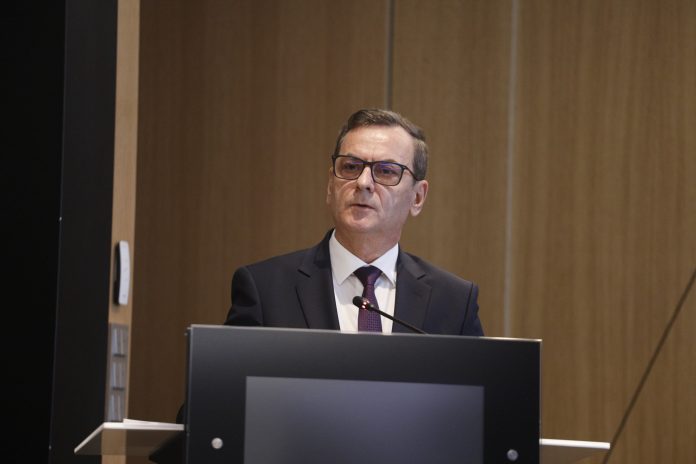
TIRANA, Nov 5 /ATA/ The Chief Justice of the High Court, Sokol Sadushi, speaking at a roundtable organized by the Ministry of Justice on the new Penal Code draft, remarked that “justice is measured not by the swiftness of laws, but by the quality of reasoning that safeguards freedom.”
The Ministry of Justice has initiated public consultations on the New Penal Code. This process is a necessary measure to enhance the criminal legal framework and is part of Albania’s commitments in the context of EU accession negotiations. The country aims to finalize the Code by the end of 2026, with its approval contingent on receiving the “go-ahead” from Brussels.
Sadushi emphasized that criticisms should not be interpreted as opposition to the reform, but rather as a “professional and moral obligation to make it fairer and more credible.”
“This critical stance should not be seen as opposition to penal reform, but as a professional and moral duty of the judiciary to make it fairer, clearer, and more credible. Justice is measured not by the speed of passing laws, but by the quality of reasoning behind every provision that impacts human rights and freedoms. Drafting the Code is not a mere technical task, but a test of the state’s legal and moral maturity,” Sadushi said.
The Chief Justice of the High Court emphasized that the process of drafting the Code has not followed a clear and comprehensive methodology, as is standard in the best European practices.
He highlighted that the lack of precise definitions of criminal offenses, along with insufficient guidance on elements of culpability and complicity, could lead to subjective interpretation and arbitrary enforcement. He further cautioned that the Code risks prioritizing state authority over the protection and guarantee of individual freedoms.
“A Penal Code that is unclear cannot guarantee justice. The current draft, with over 950 articles—many of them overloaded and ambiguous—risks prioritizing state intervention over the protection of individual freedoms. Although it reiterates the prohibition of punishment without law, it lacks a provision embodying the modern philosophy of criminal law: that custodial measure should be a last resort, and the protection of freedom must remain the fundamental principle,” he stated.
“A new Penal Code cannot operate in isolation from the broader legal framework. In parts of the draft, there is an unclear mix of substantive and procedural provisions, along with inconsistencies with the Civil Code, the Criminal Proceedings Code, and other legislation. Furthermore, treating certain traffic violations as criminal offenses creates unnecessary normative duplication, placing an undue burden on the criminal justice system,” Sadushi stated.
In conclusion, the Chief Justice of the High Court urged that the Penal Code draft be revised with transparency and extensive professional input, emphasizing that this process should be seen “not as an obstacle, but as a safeguard for the quality, integrity, and coherence of the criminal justice system.”
/e.i/j.p/r.e/sm/