TIRANA, Oct 21 /ATA/ Fatmir Xhafaj, former Chairman of the Ad-Hoc Commission for Judicial Reform and currently Chairman of the Parliamentary Commission on Good Governance, Anti-Corruption, and the Rule of Law, stated today that the Judicial Reform has brought about an institutional transformation in Albania.
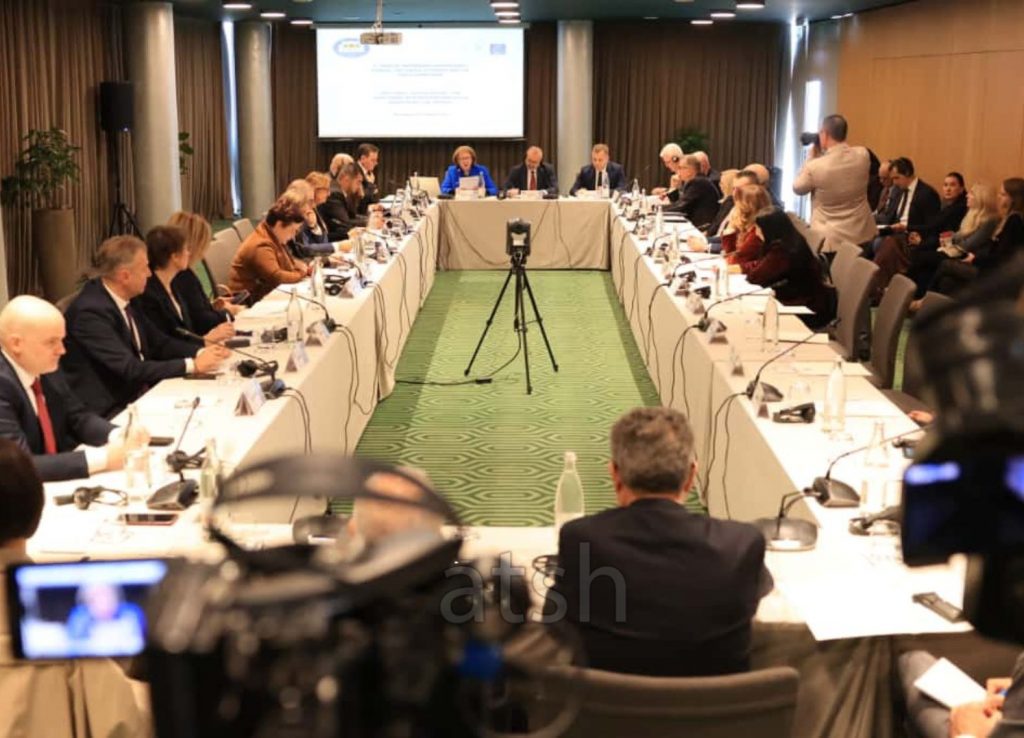
Judicial Reform was the topic of one of the three panels at the conference “30 Years of Partnership and Progress: Albania, the Council of Europe, and the Venice Commission,” organized by the Parliament.
Fatmir Xhafaj emphasized that the Venice Commission’s contribution has been crucial for the quality and sustainability of Albania’s judicial reform. He described the reform as a central part of his political and legislative career, highlighting its importance for democracy, the rule of law, and the country’s European future.
“A decade after the consensual approval of the constitutional package, one thing is certain: we have done the right thing and are on the right path, but there is still much work to be done to consolidate the reform. Judicial Reform represents an institutional transformation in Albania and is a key condition for advancing the European integration process. It was carried out through a comprehensive, transparent, and institutional process based on the highest international standards,” Xhafaj stated.
Xhafaj highlighted that the constitutional project was assisted and reviewed three times by the Venice Commission and most recently by the European Court of Human Rights.
“The reform has introduced many novelties and positive developments in the Albanian context. First and foremost, the clear separation of powers and the independence of the judiciary represent the reform’s primary and greatest achievement. The 2016 constitutional project, approved by parliamentary consensus, established clear constitutional norms and guaranteed judicial independence, creating a model for the separation of the three branches of government,” he continued.
Xhafaj noted that while judicial reform has made progress, significant challenges remain, including system vacancies, case delays, and issues with integrity, efficiency, digitalization, and access to justice. He emphasized that constitutional independence and vetting cannot justify failing to address these ongoing problems.
According to Xhafaj, “the justice system now operates on the principle of self-governance and self-regulation, through the establishment of new collegiate and monocratic institutions. These legal mechanisms have transformed the system from one that was once quietly politically dependent into one with guaranteed self-governance today.”
“Judicial Reform introduced the creation of Special Courts, Special Prosecutor’s Offices, and the National Investigation Bureau, along with a series of mechanisms that allow the system to self-cleanse, most importantly providing the tools to combat organized crime and high-level corruption,” Xhafaj added.
The Chairman of the Parliamentary Special Commission on Good Governance, Anti-Corruption, and the Rule of Law underlined that the fight against impunity has made significant progress, reinforcing the principle that no one is above the law.
“Debates between branches of government should not be seen as problematic when conducted within the framework of healthy discourse. Avoiding institutional interaction is a flawed approach and goes against the constitutional spirit. It is essential to respond in a timely manner to such issues. Today, the system requires constructive internal debate, critical feedback, and balanced opposition as much as a plant needs water. Experience from the past years of reform implementation shows the need to improve coordination, monitoring, and parliamentary oversight. The Assembly plays a key role in reflection and action. This is the moment to analyze what has been done, what is ongoing, and what still needs to be addressed,” he added.
“Implementation of the Judicial Reform over these years highlights the need to further improve and refine the process of coordination and parliamentary oversight, in which the Assembly plays a primary role in fostering interaction. This is a moment for reflection through a rational and detailed analysis of what has been done and what is currently underway. If necessary, we will have the valuable assistance of the Council of Europe and the Venice Commission in this process,” Xhafaj stated.
/e.i/j.p/sm/