

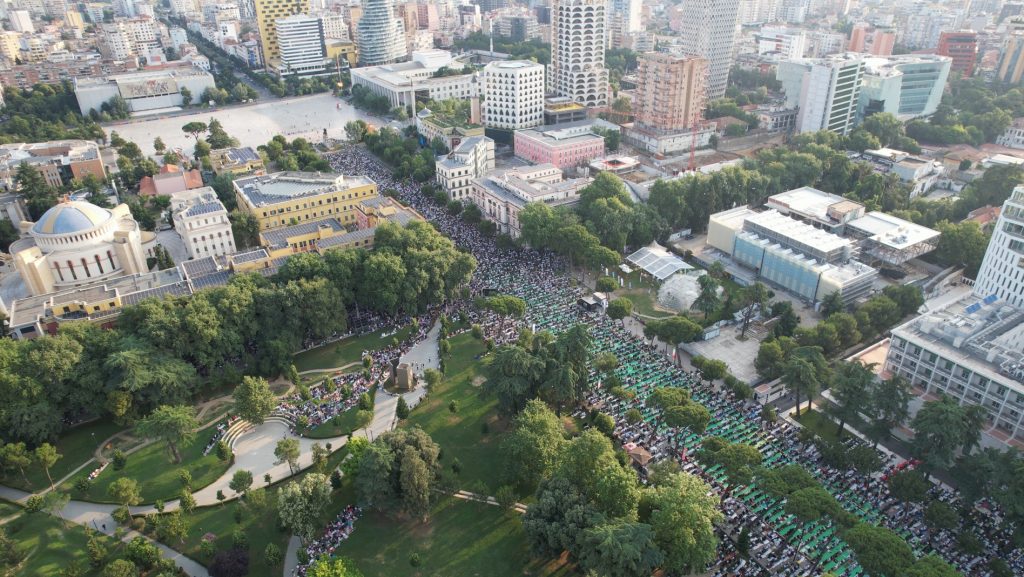
TIRANA, June 6 /ATA/ Muslim believers across the country are marking Eid al-Adha today, a sacred holiday that commemorates the profound act of devotion and sacrifice made by the patriarch of prophets, Abraham (peace be upon him).
From the early morning hours, worshippers gathered in mosques nationwide to perform the Eid prayer and honor the spiritual significance of the day.
In Tirana, hundreds of Muslim worshippers gathered to perform the Eid prayer on “Dëshmorët e Kombit” Boulevard, as well as in various mosques throughout the city.
The Eid al-Adha celebrations in the capital commenced with hafiz Enes Hyka’s recitation of several Quranic verses, creating a deeply spiritual ambiance for this significant event.
Next, the Chairman of the Muslim Community of Albania, H. Bujar Spahiu, delivered a welcoming speech extending his wishes for Eid al-Adha to Muslim believers and all Albanians, both at home and abroad. He emphasized the values of solidarity, sacrifice, and mercy that this blessed day represents.
He said, “The symbolism of this celebration teaches us that faith is not just words, but action; it is not merely a ritual, but a sincere commitment to be more just, honest, and compassionate. Therefore, on behalf of the Muslim Community of Albania, I invite all Albanians, from every background and belief, to experience this holiday with love and responsibility. Let us see each other with human eyes, help one another, forgive, and work together for a more just, prosperous, and united society.”
He further encouraged deeper reflection on sacred values in every role and responsibility, whether public or private. “Eid al-Adha invites everyone to embody goodness, integrity, and virtue without distinction: from workers and farmers who support their families through hard work; to mothers and grandmothers who raise generations with patience and faith; to young people seeking their place in society; to teachers who impart knowledge and values; to doctors committed to serving life; as well as entrepreneurs, intellectuals, and leaders who influence society’s development and thinking,” Chairman Spahiu highlighted in his speech.
The ceremony continued with a lecture by the Deputy Chairman of the Muslim Community of Albania (KMSH), Taulant Bica, who highlighted the spiritual significance of this celebration and connected the meaning of the sacrifice (Kurban) with the effort to come closer to Almighty Allah and uphold the pure values of faith.
“It is indisputable that Allah does not need our worship, nor the meat or blood of the Kurban. He is Self-Sufficient and Omnipotent. However, in our weakness, we need His mercy and closeness. Therefore, the act of sacrifice is meant to purify ourselves from selfishness, strengthen our bond with the Creator, and demonstrate our willingness to give up what we love to earn Allah’s pleasure.
Thus, let us wholeheartedly strive to perform this great act of worship during these blessed days of Eid. Let us approach the sacrifice with sincerity and dedication,” emphasized Deputy Chairman Bica.
The program culminated with the Eid al-Adha prayer, led by the Chairman of the Muslim Community of Albania, H. Bujar Spahiu, before thousands of worshippers gathered on the boulevard.
Immediately after the prayer, Elton Karaj, the imam of the “Et’hem Bej” Mosque, delivered the Eid sermon, addressing several social aspects of the celebration.
Karaj stated, “This day is a call to come closer to one another, to forgive, and to share joy with family, loved ones, neighbors, and those who may have nothing on their table today. It is a day to set aside anger, enmity, and grudges for the sake of Allah. Because Eid truly has meaning when its spirit penetrates our own hearts, softening them and turning kindness into action.”
In conclusion, the many believers gathered for the occasion exchanged their warmest wishes on this day filled with peace, love, solidarity, and sacrifice.
According to the Islamic faith, the Eid al-Adha prayer ritual consists of two main parts: first, the prayer itself, through which worship and devotion to God are expressed, followed by the sermon. On this significant day, a sacrificial animal—typically a ram or a mature sheep—is slaughtered as an offering to God. The meat is then distributed among family members, friends, and given to the poor.
/k.s/j.p/sm/








