TIRANA, June 6 /ATA/- The Ministry of Economy, Culture, and Innovation has issued a statement addressing the recent intervention at the former Spaç prison and the ongoing film project depicting the 1973 Revolt.
The response follows a wave of contrasting views on the government’s initiative to convert Spaç into a Museum of Memory.
Recently, an unnecessary cloud of confusion has been stirred up around the former Spaç prison, ignoring its extreme state of physical decay and instead making up unfounded stories about the “distortion of historical memory” or alleged “favors” granted for the sake of a film—claims the ministry describes as both misleading and inherently malicious.
For all those genuinely concerned about the fate of this symbolic site of national memory, and in light of the speculations and accusations that have been voiced, we would like to clarify a few important facts:
For more than three years, film director Namik Ajazi and writer Visar Zhiti—a former political prisoner and eyewitness to those events—have been working on an ambitious film project that seeks to depict one of the most pivotal moments of anti-communist resistance in Albania: the Spaç Prisoners’ Revolt of May 1973.
This revolt, led by individuals who had endured the extreme limits of state violence—losing their freedom, families, and even their lives—remains one of the most powerful testimonies to the unbreakable human spirit. Bringing this story to the screen, with artistic and ethical integrity, is both a moral and cultural duty—not only to the past, but also to future generations.
The challenges of bringing this film project to life are significant, due to the impossibility of reconstructing the prison camp as a set, the severely deteriorated condition of the Spaç site, and the need for authentic filming in an environment that still bears the real traces of the tragedy that took place there.
On the other hand, the Albanian government’s project to transform Spaç into an open and accessible Museum of Memory has been underway for some time. The former prison and forced labor camp of Spaç stands as the most symbolic site commemorating the brutality of the communist regime in Albania and the many acts of resistance by the Albanian people.
Countries that have experienced authoritarian regimes are increasingly engaging with the material legacy of their difficult pasts. Initiatives to transform former prisons into museums, memorials, or cultural centers have proven valuable for both civil society and institutions, helping them to understand, process, and confront the history that this kind of heritage represents.
Recognizing its profound importance, the moment has arrived to restore Spaç to the Albanian people. In line with this, a management plan was created, presented, and approved in 2024, paving the way for the successful realization of Spaç’s future vision.
The management plan was designed following a detailed analysis of the cultural heritage, its values, and preservation status, as well as after a series of consultations with stakeholder groups. These consultations involved more than 58 individuals, including former political prisoners; professionals from institutions dedicated to memory preservation, advocacy, and research in Albania; directors of museums and museum areas both inside and outside the country; representatives and members of the Mirdita community; artists and cultural professionals; and history teachers and professors.
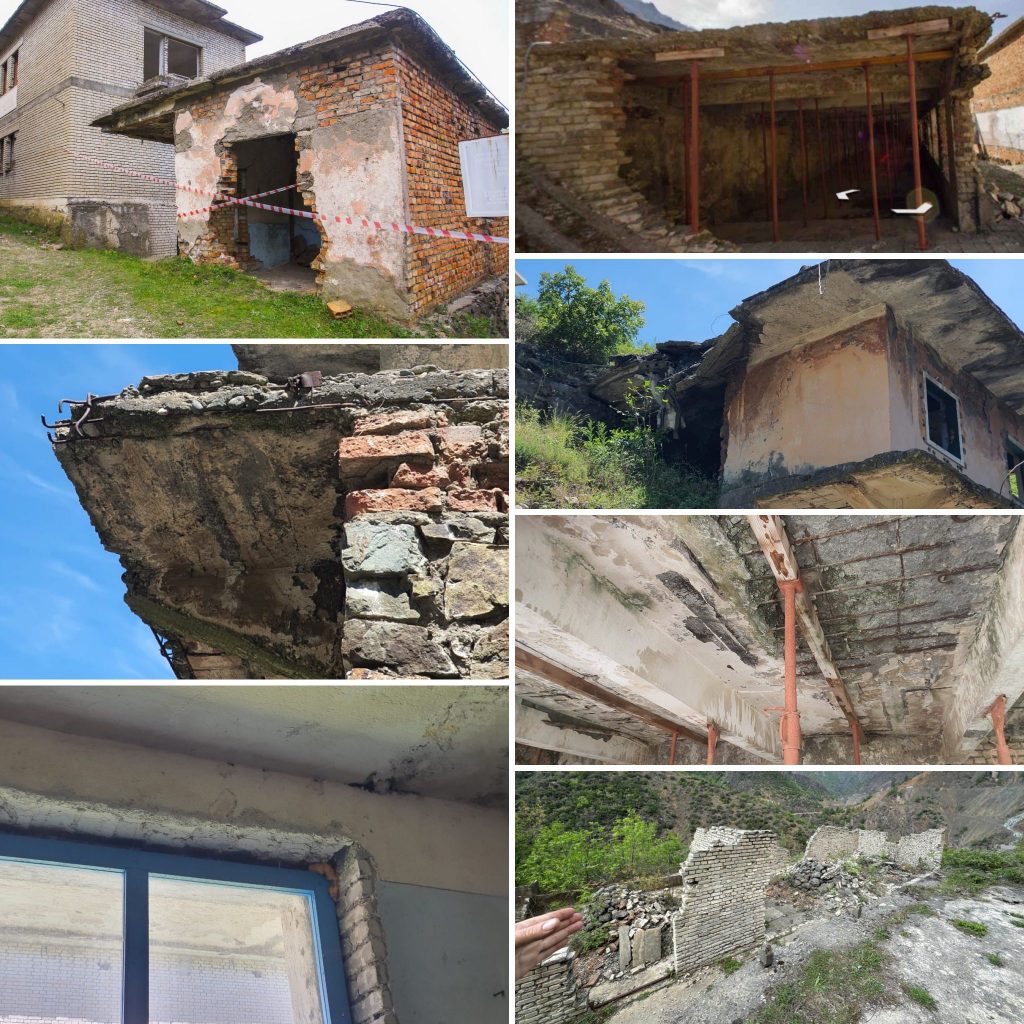
By restoring its cultural values and landscape, the vision is for Spaç to remain a site of memory and a space for both personal and collective reflection. The objective for the former prison buildings is to preserve them as close to their original state as possible, preventing further rapid deterioration, and maintaining them in a way that testifies to the past three decades—during which Albanian society has grappled with its recent and painful history. The visible wear on the structures symbolizes the increasing detachment from the nation’s difficult memories. Yet, the current level of decay presents an urgent threat of permanent loss to this important legacy.
Further details on the proposed preservation interventions, possible reconstruction of key elements, restoration of pathways and entrances to the mine tunnel, and strategies for interpreting the cultural heritage are also outlined in this plan. According to it, the necessary procedures will be undertaken to establish the Museum of the Prison and Forced Labor Camp—a museum dedicated to resistance against the communist dictatorship. The museum will focus on the struggles and stories of suffering, hardship, and resistance that took place in Spaç, from the pivotal event of the 1973 Spaç Revolt to the numerous everyday acts of survival, and the loss of humanity, dignity, and solidarity imposed on the prisoners. Additional information about the planned museum collection, the steps required for its creation, and the specific operational strategy will be set out and publicly consulted step by step.
It’s important to recognize that the timeframe needed to establish a fully compliant museum surpasses the planned filming start date, which has already been secured as a unique co-production opportunity with a renowned Italian studio. Therefore, we proposed that the larger rehabilitation project prioritize some targeted conservation and reinforcement efforts. Given the high risk of accidents at the site, these measures would ensure physical safety and enable the authentic recreation of the 1973 atmosphere through special effects and set design—while keeping budget and interventions to a minimum.
So why was there no outcry years ago over the blue windows, the destruction of dozens of monuments and structures, the landslides and erosion resulting from neglect, the collapse of beams and floors, the loss of artifacts and materials, or the hazards posed to visitors? Just look at the photos! And now suddenly, the announcement of a film is seen as a threat to Spaç?
The interventions are not intended to alter historical memory; on the contrary, they are carefully designed to preserve and enrich it. At the start of the work, signs of rehabilitation were visible, but these are integrated and harmonized through scenographic and restorative techniques, closely resembling the site’s original condition at the time.
This film project, which aims to bring to the screen an extraordinary story of courage, suffering, and idealism, is neither a political initiative nor a non-transparent maneuver. It is a sincere and arduous effort to remember and honor a dark yet heroic chapter of our history.
Any voice that seeks to use this situation for political gain or to sow doubt and division is, in fact, undermining the effort to document a truth that was silenced and denied for decades.
/sm/