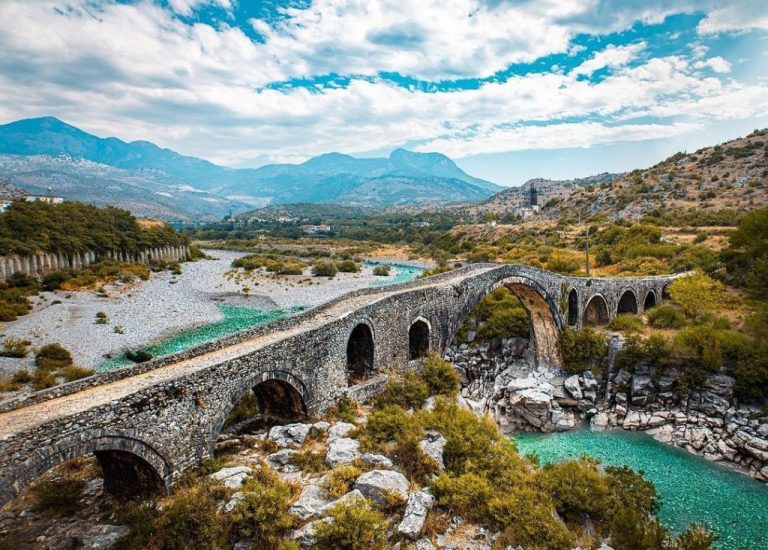
TIRANA, Jan 29 /ATA/ – The Mesi Bridge (Ura e Mesit) over the Kir River in the north-western Albanian region of Shkoder has become a tourist attraction after the structure underwent a restoration project recently.
Built in the 18th century, this beautiful bridge spans the Kir River in the village of Mesi, approximately 8 km north-east of Shkoder, and is a symbol of the city’s rich history and a gem of Albania’s national architecture and heritage that is attracting hundreds of visitors daily.
It is the longest and best-preserved Ottoman bridge in Albania, built along the ancient trade route Shkodra- Kosovo, a route which date back to the pre Roman times.
The landmark monument, which exposes the connection between past and the present, is a must-see attraction for local and foreign visitors to the region of Shkoder.
The bridge’s architecture and structure, as well as the legend telling the story of its construction, are quite intriguing to this day. The legend has it that a Turkish merchant had dug several pits to slake lime. For almost 20 years, the villagers waited for the merchant to build the bridge. Finally, he came back, gathered the inhabitants and began building the bridge. The lime, which had been in the pits for 20 years, had such strength that it bonded the bridge stones quite well. According to legend, this bridge was built with stones and slaked lime, without cement or iron.
The 108-meter long and 3.4-meter wide Mesi Bridge is the highest river crossing in Albania. The bridge features 13 stone arches and it is paved with stone slabs.
The bridge was built by the local Ottoman pasha Kara Mahmud Bushati in the 18th century, around 1770 at the point the river was crossed on the trade route between Shkoder and Prishtina. The idyllic surrounding landscape gives the bridge an even more picturesque view.
The surrounding landscape—with clear waters and rocky terrain—adds to the bridge’s charm, making it one of the most picturesque spots in Shkodër and a growing attraction for tourists.
/u.sh/