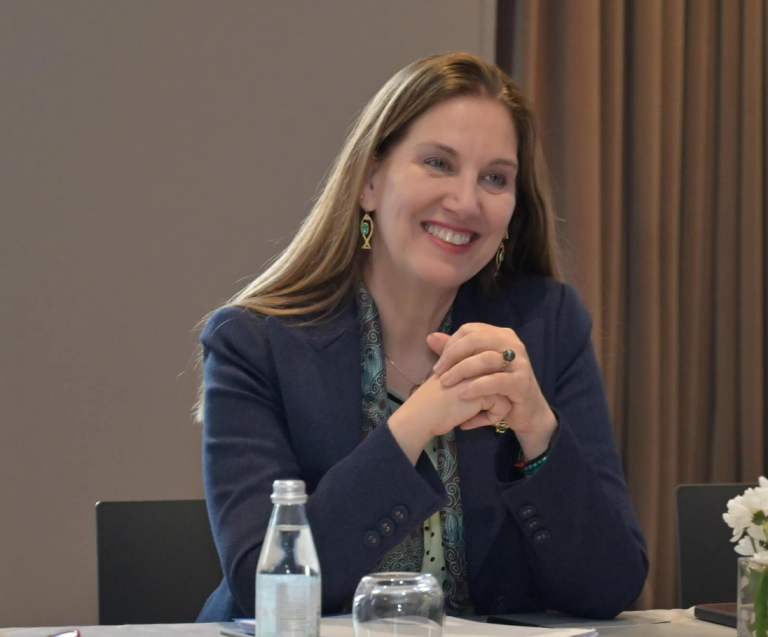
TIRANA, Nov 25 /ATA/ In an interview with the Radio Free Europe, Albania’s Minister of Tourism and Environment, Mirela Kumbaro, noted that tourism has evolved into a full-fledged industry, now spread across nearly the entire country and operating year-round. She anticipates a further increase in the number of foreign visitors, while acknowledging that Albania was not fully prepared for the tourism boom it experienced over the past two years. Kumbaro highlighted the goal of fostering elite tourism but also shared positive news for those seeking more public spaces along the coastline. To manage the rising number of tourists, she pointed to waste management and public transportation as pressing challenges that need to be addressed.
Radio Free Europe: According to a report published by the United Nations World Tourism Organization (UNWTO), Albania ranks second in the world and first in Europe for the highest growth in tourism. How meaningful is this indicator for the country?
Mirela Kumbaro: For Albania’s global image and reputation, as well as for its economic development, tourism is undoubtedly the most important sector of the economy. For the past two years, we have been talking not just about tourism as an economic sector, but as an industry. This means that what we predicted eight years ago— that tourism would be the future of Albania and its economic development— is now tangible in the economy and recognized by international organizations that measure sectoral growth, such as the World Tourism Organization. In its six-month barometer, Albania ranked second in the world for the increase of international tourist arrivals and first in Europe compared to the pre-pandemic period [COVID-19]. Albania has not only bounced back, but has exceeded all expectations. According to our forecasts, we expected to reach 10 million tourists by 2027 or 2030, but we have already hit that target in 2023. This is not due to a sudden boom in one year, but the result of work that has been ongoing since 2014, which we conceptualized as part of the “Urban Renaissance” program. It brought about a psychological-aesthetic and psychological-architectural transformation, as well as a new synergy in investment and vision between the public and private sectors. Two important new developments confirmed in the last two years are: the expansion of tourism across the country and throughout the year. These factors make tourism sustainable, create a new map, and encourage tourists to see Albania not only for its coastline, but for many previously undiscovered destinations.
Radio Free Europe: The same report ranks Albania as the country with the highest growth in tourism revenue worldwide. What has been the impact on the entire business chain within the tourism sector?
Mirela Kumbaro: This is one of the best things for the economy. Revenues from tourism have seen significant growth. In 2022, tourism generated 2.8 billion euros; in 2023, 4.2 billion euros, and according to the Bank of Albania, in the first half of this year, there was an increase of 500 million euros compared to the same period last year. It’s not enough to just talk about the number of visitors; what’s important is how much revenue they bring in.
Radio Free Europe: The 2024-2030 Tourism Strategy envisions dividing the country into six tourist regions. What will this plan bring?
Mirela Kumbaro: We have a lot of work ahead to further formalize the Albanian economy, especially in the tourism sector. This is why, in the new strategy we are proposing to the government, “Tourism Albania 2030” — which is expected to be approved in the coming weeks — we foresee interventions in the fiscal system, information systems, and the reform of several agencies, such as the Albanian Investment Corporation, the Agency for Investment and Development, and the National Tourism Agency. This is a form of soft diplomacy, a benefit for the nation and for Albanians wherever they may be.
Radio Free Europe: During the presentation of the strategy, you mentioned that “for every 1 km of beach, there will be at least 300 meters of public beach.” How feasible is this commitment, especially considering you have described it as a significant challenge?
Mirela Kumbaro: In Albania’s tourism offers, the coastline is one of the main attractions. However, our experience over the past years has taught us how to better manage this space, developing a more balanced relationship between the beach as a public space, which should be accessible to everyone, and the need to strike a balance with the interests of the private sector. The new beach regulation reflects this balance, focusing on promoting sustainable, serious, and long-term investments in the hospitality sector.
While we are seeing a significant influx of both local and international tourists, we still fall short of the necessary capacity in terms of accommodation to meet this demand.
We view the coastline as a shared resource and an added value for the sector that has invested in hotels and accommodations. Therefore, we believe that beaches, as spaces that can be managed by private entities, should be made available to businesses that operate hotels. However, we aim to reverse the trend where small businesses dominate beach spaces by offering simple service structures—such as umbrellas and lounge chairs—as their main business model. This is not acceptable! Beaches must remain free and public, with municipalities being responsible for their maintenance and management, in cooperation with the National Coastal Agency.
Raising public awareness about keeping beaches clean is crucial, and 2025 will be a challenging year in this effort. At the same time, we plan to nearly double the public beach space. We will allow municipalities to offer umbrellas and lounge chairs at lower prices than the private sector, giving tourists more options to choose from. Additionally, we have introduced a new concept, which, due to the challenging terrain, will not be easy to implement: ensuring that for every 1 kilometer of beach, at least 300 meters will be designated as public space. Furthermore, where the beach is sandy, the area up to 10 meters from the shoreline will remain free, while in rocky areas, this distance will be reduced to 7 meters.
Radio Free Europe: In the face of the tourism boom, Albania’s Prime Minister, Edi Rama, has stated that protecting and preserving nature will also be a challenge. How will this balance be achieved, and how will this equilibrium be maintained?
Mirela Kumbaro: Natural destinations connected to biodiversity and protected areas are becoming more sought-after and increasingly important because they sustain tourism throughout the year. When people visit a national park or a protected landscape, they don’t just want a short walk—they want to stay and immerse themselves in the beauties of the area. In our legal reforms, we have prioritized preserving the principle of sustainable tourism to ensure a thriving local economy. Abandoning rural areas and flocking only to the south or Tirana is not the solution. The reality is that we are seeing a rise in visitors to protected areas. From 4 million last year, there were 4.9 million visitors in the first ten months of this year alone.
/sm/