TIRANA, Sept 25 /ATA/ The Center for the Study of Democracy and Governance presented on Wednesday the findings of its new study on the performance of the Special Prosecution Office (SPAK) and the Special Courts against Corruption and Organized Crime.
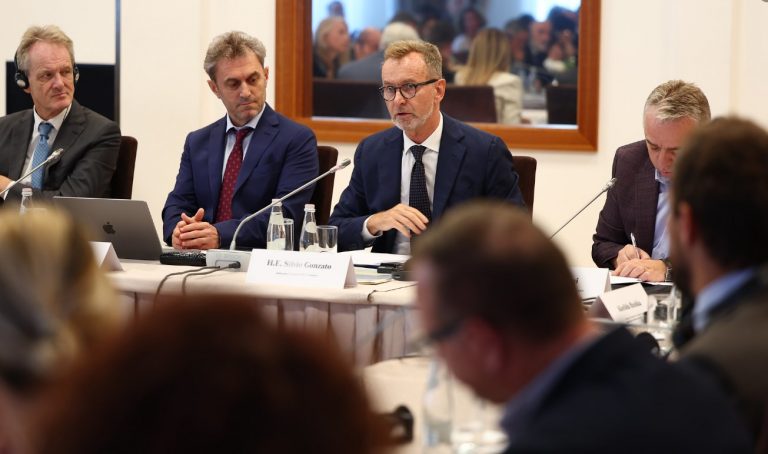
EU ambassador in our country Silvio Gonzato, said that fighting corruption and organised crime is at the core of strengthening the rule of law and a crucial objective for the countries in the enlargement process. It is a complex and challenging endeavour and requires a comprehensive approach.
The creation of SPAK as a separate structure for the investigation, prosecution and adjudication of corruption and organised crime cases has certainly been a cornerstone of this process – decided and carried by Albania as part of a strong political and societal consensus. The main purpose for creating SPAK was to strengthen the integrity, independence and effectiveness of the authorities responsible for investigating and adjudicating high-level corruption and organised crime cases.
And SPAK has been showing encouraging results. SPAK investigations have resulted in the conviction of several high-level officials. It has systematically used financial investigations (“following the money”) and as a result asset confiscation has improved. The Special Prosecution Office has developed a solid cooperation with its international counterparts including in the EU, to tackle organised crime.
This progress has been noted also by the Albanian people whose trust in the justice institutions has recently increased.
The road towards setting up a new institution such as SPAK, with a highly complex and challenging mandate, has not always been (and still isn’t) smooth and easy. Like any new institution, it needed time to reach cruise-speed. SPAK has had to deal with a legacy of a culture of impunity in the country, and– due to the very nature of its work of investigating high-profile corruption cases – has been increasingly thrown at the centre of attention. By it’s by no means the only actor and factor in the fight against corruption.
Some of the challenges SPAK is facing have been clearly identified in the EU screening report and also in the rule of law report on Albania released last July, such as: the need to enhance human resources and operational capacities; the need for deploying more sophisticated investigative tools; The need to further increase the investigative capacity of the National Bureau of Investigation, as an integral part of SPAK. And another key challenge is the low number of referrals that other state institutions provide to SPAK that would enable it to initiate investigations and conclude them successfully.
The EU will continue to stand by this institution to enable it to exercise its mandate. This also means that we will continue to support SPAK in overcoming some of the challenges it has been facing. And whilst recognising these challenges, I’d also like to point out that, when assessing the overall country’s efforts in fighting corruption and organised crime, it is very important to keep in mind that SPAK is only one part – albeit a very important one – of the country’s overall arsenal, the ambassador Gonzato said.
/sm/