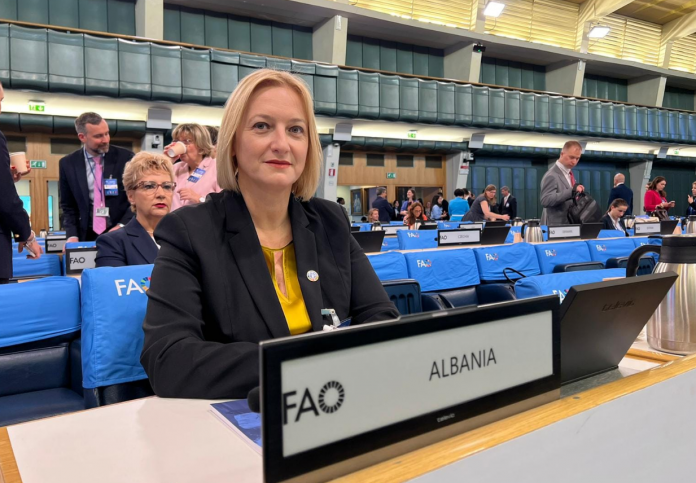
TIRANA, May 15 /ATA/ Minister of Agriculture and Rural Development, Anila Denaj, participated in the 34th FAO Regional Conference, which is taking place in Rome from May 14-17, 2024.
In a press release, the Ministry of Agriculture and Rural Development announced that, during the speech held in the 2nd session of this conference, Denaj outlined the strategy for the development of agriculture, while focusing on 3 main issues such as the establishment of the Innovation and Excellence Agency , the implementation of FAO and WB projects, as well as the introduction of curricula in vocational education about innovations in modern technology, which are very important initiatives that are being implemented.
“To begin with, the FAO project, which is set to start very soon, will develop a new platform for farmers, which will be the key to their economic perspective, but also the activities in their daily tasks. So, we are also working on the infrastructure and sharing of information, where we project our near future”, said Denaj.
She emphasized that two components that we are launching are the national digital strategy for agriculture, and an action plan, which will be an opportunity to learn from the experiences of other countries and adapt them to our context.”
“This strategy can be an effective tool for policy-making. While the second component besides the Farmer’s Portal, which is directly related to the distribution of information to farmers, is the fact that we will also cooperate with the ILO on education. We have designed a process where vocational education gains a lot of knowledge about innovations in technology today. Thus, the vocational education curriculum will contain knowledge about all the experiences exchanged not only at this event, but also in other countries that are suitable for us as well”, said Denaj.
The Minister highlighted the beginning of a project in partnership with the World Bank, named “Climate Resilience and Agricultural Development”, which, according to the Minister, aims to modernize irrigation-drainage schemes in two important agricultural areas of Albania, which will be pilot projects, and serve as examples in other areas of what will be more efficient, less costly and better irrigation-drainage systems in Albania.
/r.e/sm/