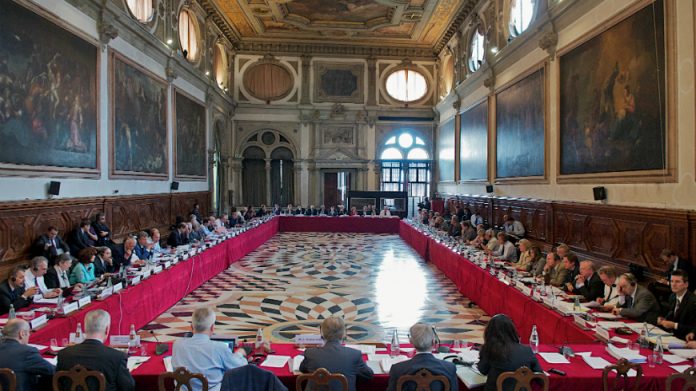
TIRANA, Oct 19 /ATA/ – The Venice Commission has published its full amicus curiae opinion on validity of the June 30, 2019 local elections in Albania.
The Venice Commission responded regarding three questions raised by Albania’s Constitutional Court.
Regarding the first question whether Article 131, point 1, letter “e” of the Constitution could be interpreted as the Constitutional Court having jurisdiction to decide on the constitutionality of the election, the Venice Commission notes that it “considers the word ‘functionaries’ in Article 131 (1) e) as having the same meaning as persons exercising public function. However, this does not imply ipso iure that the Constitutional Court is competent to address electoral disputes in the field.”
In its reply to the second question: Given that the principles of periodicity of local elections and political pluralism are provided as fundamental principles, what would be the interrelation between them in a situation where there is a risk of violation of each of these principles and which one could prevail over the other, the Venice Commission notes that “, the principles of periodicity of elections and of political pluralism are unlikely to conflict per se one with each other since they are expressed in very different types of rules. Pluralism may be a legitimate aim for interfering with periodicity, but for that aim to prevail, the interference should have a legal basis and be proportionate. Parliament has a wide margin of appreciation to decide on providing a legal basis for postponing elections; in the absence of such a basis, the Constitutional Court could consider the postponement as unconstitutional.”
Regarding the third question as following: In a situation of legal uncertainty climate, did the actions of public authorities and political parties violate the voters’ right to have meaningful choice? Should they have ensured voters’ highest interest? The Commission replies: “The Code underlines that “political parties precisely aim to participate in the political process, mainly presenting candidates to elections. It however does not mean that they have such an obligation. Political parties are therefore private associations representing their members’ views, without the obligation to represent a part of the society and without the obligation to take part in elections, despite this may be one of their main objectives. Boycotting may be therefore a means of political activity, among others.”
“It therefore remains the co-responsibility of the public authorities and the whole political spectrum to restore trust in the Albanian institutions and in electoral processes. This implies the responsibility of all these stakeholders to promote political dialogue among all political forces as well as among national institutions, such as the Central Election Commission, inter alia. This also implies restoring a meaningful choice for voters. All these elements are sine qua non, but non-exclusive, preconditions to democratic elections,” the Venice Commission says in its opinion.
/j.p/r.e/u.sh/