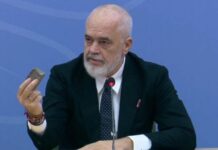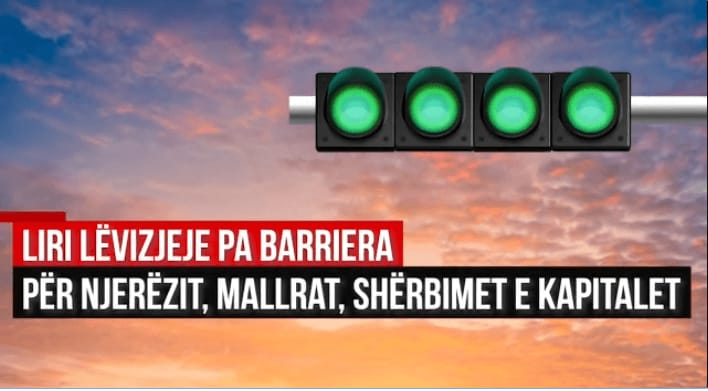
TIRANA, Oct 7 /ATA/ Prime Minister Edi Rama stated in his address to the Tirana Forum on Infrastructure Connection with the countries of the Western Balkans and Europe, that the Open Balkan is a natural development in the Berlin Process.
“The connectivity map is clear. It has been designed for some time now. “Financing and operational processes for the implementation of what has been agreed upon regarding this map is a very big challenge,” said Rama.
“I still insist that through the Open Balkan we will have an additional mechanism that will be more efficient to promote the capacities we have in order to deliver more in this regard,” said Rama.
“Investments in connectivity, coupled with the joint efforts to make our region barrier-free as soon as possible in terms of the tariffs is the right thing to do and the right way to go, ” said Rama.
“There are very confounding discussions taking place about the Berlin Process, about the Open Balkan, while for me it is very clear, the Open Balkan has been inspired by the Berlin Process, it is a natural development in the Berlin Process. It is an instrument established in the region to coordinate all efforts at regional level to implemente the principles and objectives of the Berlin Process itself, while the Berlin Process alone clearly has a problem. The problem is that the authorship is outside the Balkans. Which means that despite the goodwill, anyone from outside who is engaged in the Berlin Process, actually has much more to deal with in daily life and cannot focus only on the Balkans, which we can and should do, ” said Rama.
So, PM added, it is the same as a project implementation unit. Donors contribute with funding and projects, but they always need the project implementation unit in order to follow through with the implementation. So the Open Balkan is the implementation unit of the Berlin Process. It is as much comprehensive as the Berlin Process. It is open to improvement. It is not a process that affects or disturbs this process, but it is a process that requires the implementation of the 4 freedoms. ”
Rama went on saying that, “what we invest financially due to the nature of this plan is always dependent on the capacities and performance of more than one country. Every road, every road segment, every railway segment, every digital segment or whatever we do, in an interconnected energy network, cannot be built in a fragmented way and cannot be separated from the other.”
“We want to advance the Adriatic-Ionian corridor and we are currently engaged in a solo exercise, while the years go by and the project is far from being ready in terms of involving countries that are supposed to have this connection, namely Albania, Montenegro and Croatia. For this we are prepared very seriously and thoroughly for an investment, which should secure financing through direct contracts on roads, which means toll roads. So we need to build the corridor, but to have an alternative solution for everyone, so not only the corridor, but also an alternative for the roads, ” said Rama.
“Finally, we see the kickoff of work on the Tirana-Durres railway, which has been a long process. I would say not even a usually long process, but even more than that with the EBRD for reasons that have not been easy to understand, and yet finally things are fine and we can start. “Currently we need to connect Durrës with Montenegro, in the sense of railway, because otherwise it does not make sense,” Rama said.
“On the contrary, the connection of Durrës with Hani i Hotit and then from Hani i Hotit with Montenegro will promote trade. At the same time, we are certainly interested and we look forward to working on the Durrës-Pristina railway and then connect with Nis, which again brings all the investment in a wider network, not only regional, but also in a European one, ” said Rama.
“Next is the segment between Durrës and North Macedonia that will again be meaningful for the region and will be very important in parallel with the work we have started on the new commercial port of the city of Durrës, which will be larger, way better and much more decent from the environmental point of view compared to obsolete infrastructure that we had, that we have and that we still call a port, ” said Rama.
Meanwhile, Rama added, “of course we hope to combine the Durrës – North Macedonia railway with road infrastructure projects, but this must be done after overcoming some obstacles in the current situation.”
/j.p/sm/