TIRANA, July 7 /ATA/ – It was a rushed start for my morning journey, and I was still fiddling with pots of cream and tubes of sunscreen as the minibus set off, the BBC travel writer Elizabeth Gowing starts her feature story on Albania.
“Our bus was filled over capacity with people and their bundles,”Gowing writes surprised at their luggage.
“Luckily for my curiosity, a woman – who later introduced herself simply as “Naim’s wife”, in an indicator of the area’s lingering traditional views towards women – was keen to tell the whole minibus about just what was in that pillowy pile of herbage she was bringing back home from Kukës.
It turned out she was talking about cowslips, one of the many medicinal plants that are wild harvested in Albania.
So, do you go out collecting the flowers?” I asked.
The whole minibus answered me: “yes!”
Once my interest had become clear, the journey became an illustrated lecture.
I was learning a new way to parse the countryside.
All of the flowers these collectors found eventually made their way off the mountains and down to Kukës to be sold for export.
Our minibus’ destination was a village called Çajë, pronounced chai. I was travelling to a village called “Tea”.
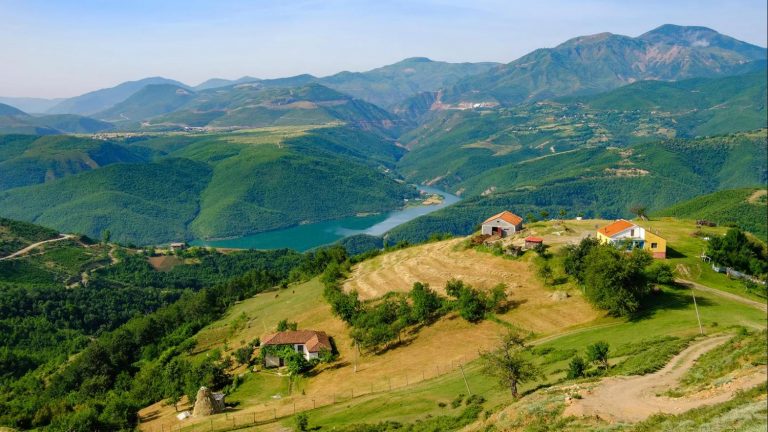
This area is typical of much of Albania, which is 77% mountainous, and benefits from a Mediterranean climate and land that had little chemical contamination.
All these factors make Albanian wild-gathered herbs particularly sought-after internationally.
at Donika Musaj’s family’s guesthouse, Bujtina Musaj, I hoped I might be greeted with some of Albania’s signature so-called “mountain tea”, a comforting brew, as yellow as lamplight, that’s made from the ironwort plant, Sideritis syriaca.
This family, and those represented on the minibus, were just some of the more than 100,000 Albanian households involved in the cultivation or harvesting of medicinal and aromatic plants. Across the country, that’s roughly one in every seven homes linked to this sector, which generates up to $28 million in exports.
Between 2018 and 2019, that was made up of 12,000 tonnes of cowslips, bilberries and other plants in demand by foreign gastronomy and pharmaceutical markets.
Anila Aliaj from the NGO, Connecting Natural Values with People (CNVP) – which has a project developing this sector with Swedish Embassy funding and currently working with more than 1,000 farmers – explained more about what the collecting sacks and cutlasses make possible.
“This sector gives opportunities to women to have an income and to become economically independent of their husbands,” she said.
“”But women shouldn’t just be workers who gather the plants, but also decision-makers in trading the product,” Aliaj added.
Aishe Ivani, the Çajë village nurse, echoed how medicinal plants help her community with independence.
She also goes out gathering the plants in her spare time, and she says that with access to “the nature God has blessed us with, we’re our own doctors.”
For those of us who find it easier to incorporate into our wellness regime something in the bathroom cabinet rather than the kitchen cupboard, Albania’s mountain plants offer one other hope.
The oil of the so-called “everlasting flower” of helichrysum is another ingredient in “restoring” night serums and “regenerating” facial products.
this is another plant grown in this clear mountain air and used by cosmetics companies around the world for its properties for preserving skin tone.
As I ventured even further north in Albania, at the side of the road I found another group of women with beautiful complexions pulling up leaves. They were working on helichrysum, and I asked if I could take a photograph of them.
“Yes, but please make me look beautiful,” one of them called out with a smile.
Thinking of the precious oils and petals they supply in a direct line to our cosmetics companies; it makes more sense for me – for all of us – to be asking this of them to make us look younger and beautiful.
/ /ervo/ u.sh/