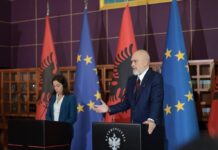
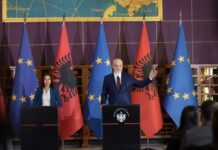
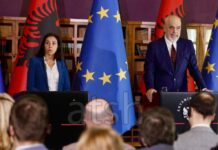
TIRANA, December 22/ATA/-Tirana summit was the third to materialize the regional Mini-Schengen. This initiative is seen as a strategy that will not only accelerate the economic and social development of the region, but also the timing of EU membership.
A region with unified labor market and systems, open borders, transportation and trade facilities, attractive to foreign investors! A region that aims to accelerate rapprochement with living standards and EU values through co-operation between countries so that to shorten accession time. A Western Balkans that aims to guarantee 4 fundamental freedoms: the free movement of people, goods, services and capital.
These intentions were clearly expressed by the leaders of the four Western Balkan countries participating in Tirana Summit that concluded its proceedings on Saturday (21.12.2019). Montenegro’s President Milo Đukanović, President of Serbia Alexander Vučić, Prime Minister of Albania and summit host Edi Rama and Prime Minister of North Macedonia Zoran Zaev agree on the necessity of efficient functioning of the Balkan Mini-Schengen. They envisage its realization in practice as a strategy that will accelerate the region’s economic and social development and EU accession time, which remains an unchanged aspiration for all the six.
Origin of the Balkan Mini-Schengen
In fact, the initiative to create “de jure” and “de facto” Balkan Mini-Schengen is not new in its core. The strengthening of regional co-operation as an efficient instrument for new impulses in the process of Western Balkan’s EU integration was first articulated by German Chancellor Angela Merkel in August 2014, when she launched the diplomatic initiative known as the Berlin Process. The basis of the current initiative is the agreements reached within this process, but not implemented, during the 5 years of this process. Leaders of the four WB countries said unanimously at the Tirana summit that the Mini-Schengen is a “Berlin plus”.
Does Balkan Mini-Schengen replace EU integration?
Clearly and unequivocally the four WB leaders stated that this was unlikely to happen. “This process is fully coherent with the ambition of all WB countries and their commitment to become part of the European family. By joining forces, we accelerate the “EU integration process and create” in our space the standards that respond to the 4 EU freedoms: freedom of movement of people, goods, capital and services, “said PM Rama.
PM Rama said at the joint press conference that, “Western Balkan countries have all the strength to implement agreements reached earlier in context of the Berlin process, CEFTA or other initiatives and roundtables”.
Meanwhile, Montenegrin President Milo Đukanovic praised the Balkan Mini-Schengen initiative as “an excellent opportunity to improve trust between countries in the region and strengthen capacities for co-operation within broader EU initiatives, in which we wish to integrate”.
The President of Serbia, Alexander Vučić, considered regional cooperation “extremely important”. North Macedonia Prime Minister Zoran Zaev focused on border facilities in the movement of people and goods. He said that a “one stop shop” agreement has already been signed at the border crossings, where electronic systems will be used and citizens across the region will cross the border with ID cards. “There will be a unified, single procedure for issuing work permits. North Macedonia and Albania expect positive messages by spring of 2020,” said Zaev implying the possibility of opening membership negotiations at the EU-Western Balkan spring summit in Zagreb.
Vučić: The rules of the game are not changed
The hopes of North Macedonia and Albania next spring reinforce the notion that the Balkan Mini-Schengen does not replace EU integration. “We want to be members of the EU. That’s why we have been working for a while. We are not ready to change the strategic direction. We have not received any new information that would make us hesitant and say that we do not want to go to the EU. On the contrary, we have recently stated that we are against any ideas to change the rules of the game now. The rules of the game have been set in Thessaloniki in 2003. We do what we can: organizing the region and it does not depend on the great powers,”said Vučić.
At the Tirana summit, it was highlighted the fact that the Balkan Mini-Schengen initiative is supported by the USA and the European Commission, which will provide the region with 1.2 billion Euros in funding next year for progress in realizing regional co-operation.
Initiative for the future
PM Rama called the Balkan Mini-Schengen initiative – an initiative for the future of the region. He appreciated Kosovo authorities’ refusal to attend Tirana summit wrong. “This initiative is comprehensive, it does not exclude anyone, there is no condition. The four countries in the region have also opened the door for Kosovo and Bosnia and Herzegovina that need development. Rejection is suicide in economic and political terms. This initiative is a bridge between the past and the future. The past divides us, the future unites us. We can heal the wounds of the past only through cooperation,” said PM Rama.
Tirana summit was attended by representatives of the European Commission, the US State Department, the World Bank, and the European Bank for Development and Reconstruction, the European Investment Bank that are supporting the Balkan Mini-Schengen initiative. The next summit will take place in Belgrade in early February 2020./j.p/p.s./