TIRANA, 13 July /ATA/ – “The Albanian woman became recently a topic that sparked interest in many colourful ways. Alas, it never grew into a more serious-toned discourse. Regrettably, focus is largely placed on the glitz and glamour of this show. We feel it is high time that all the clamour of rendezvous, dance amusements and makeup delight are restrained, while the conscious part of our society turns its attention to the social issues our life as a country, of which, that concerning women is on the forefront”.
The above is an editorial note published in April 1938 in “The Albanian struggle”, a monthly literary magazine by Branko Merxhani, preceding the article entitled, “Feminism and the Society,” written by the first Albanian vocal feminist, Olga Plumbi.
While thinking of what I could talk about in this summit, I asked Edi’s mother: “What is the biggest challenge women face nowadays?
“To stand up to the hostility and preserve the superiority of substance over form,” she answered.
Then, I went on to my mother: “What is the biggest challenge facing women today?” “Before thinking of the challenges, don’t forget to remember the achievements that my grandmother could not even fathom for me, while I am able to imagine endless possibilities for my nieces,” she answered.
I asked Rea, our 29-year-old daughter: “What is the biggest challenge for a girl today?”
“To get to know and fully embrace her own quintessence,” she answered.
Further, I asked Greg, our 28-year-old son: “What is the biggest challenge women face nowadays?”
“Fight for education and employment and the challenging of patriarchal mindsets in the rural and peripheral Albania,” he answered.
I asked a friend of mine, a very capable professional, “What is the biggest challenge facing the professional woman today?” “To ask for more, to dare and blaze trails, leaving footprints that will inspire other girls and women to follow and elevate her to new heights,” she answered.
I went on to ask other people, as well, getting answers that completed the mosaic of the challenges faced by women in a small country like Albania that history tested for half a century with a dictatorship that was among the harshest compared to other similar countries and with an arduous transition in the last 30 years.
It would have been impossible for the country to deal with these two challenges without the girls and women who became examples of a selfless sacrifice to keep family and societal balances! The Albanian woman has been, is and will remain a hero in the vortex of a history that has been less than generous with her. Allow me to remind you that communism marched into the lives of Albanians bearing the flag of emancipation for women, who had lived for centuries ostracized from social life in most of the country.
While it is impossible to address the mosaic of challenges faced by the Albanian woman, both in its historical and actual complexity, with all the mind-boggling changes of a new era, I will focus on the exceptional potential that the Albanian girls and women have to give a more qualitative contribution to the society, and to the advancement their representation at all levels. This, I believe, is one of those issues that tops the women agenda in every developed and developing country, therefore I believe that, given the Albanian reality, the two moments I will touch upon discuss are indeed meaningful.
Albanian women have never been as educated as they are today. In our mothers’ generation, only 5% of the women had attained university education. Currently, figures speak of six times more girls and women between 25 and 39 years of age who boast a university degree. As we speak, there is no gender gap in compulsory education, giving us reason to come up with an optimistic projection that it will not be long before the narrow gender gap that still exists in secondary education is bridged. Girls who attend higher education nowadays are many more than boys and that would have been unthinkable a few decades ago.
However, this potential becomes weaker in the labour market. Employed women are less than employed men. There are twice as many women compared to men who are engaged in unpaid work in the family business. Women are the first to leave the labour market, mainly due to motherhood challenges that have increased in this day and age, whereas many others still endure the pressure of a patriarchal mindset that keeps them from showcasing their skills and talents.
Against this reality stands an enormous potential that builds on an entirely new perspective on women compared to the past in terms of the representation rates in administrative and political decision-making that are rather significant and encouraging; even impressive, I would say.
30% of the current MPs are women, 50% of the representatives of municipal councils in the country are women, 50% of Government ministers are women, who currently are at the helm in areas that women were never entrusted with before.
Currently, energy and infrastructure are led by a woman minister. The same goes for the finance and economy. Women are ministers of defence, justice, education, health, culture and relations with the Parliament.
The Ombudsperson is a woman, the Attorney General is a woman, the President of the High Judicial Council is a woman, and so is the Chair of the Independent Qualification Commission in charge of vetting judges and prosecutors. The Chair of the Special Appeal Chamber is a woman, the head of the Serious Crimes Prosecution is a woman, and so is the head of the largest prosecution office in the country, Tirana’s Office.
47% of the deputy ministers are women. 40% of the central institutions and 45% of the General Directorates are headed by women.
30% of the private business owners and administrators are women and more than 40% of the top management positions in private companies are filled by women.
This significant group of girls and women stands on top of the institutional architecture and is with no doubt the result of a new social and political ability to appreciate merit and to emphasize the need for women in decision-making. This new ability stems from a long, arduous and persistent investment in all the less-than-easy struggles for development and emancipation. These are efforts that started almost three decades ago from a core group of civic activists to introduce gender quotas in politics and increase the representation of women in public administration. On the other hand, I believe that this new ability is also the result of a distinct integrity and admirable persistence of the girls and women, thanks also to two key factors among others: Mothers who were not willing to merely passing on their own social status, but who struggled so that their daughters asked more from the future when it comes to their gender position. And, second, teachers, who, being mostly women, taught us for women it is much more critical than for the rest to know how to think of the future costs of present decisions.
It would not only be desirable but also a payback that all girls and women who are today at the highest levels of representation in politics, public administration or private sector are due if they posed everyday a question to themselves:
What have I done to make politics, governance and private entrepreneurship more open and friendly for girls and women like myself? What is it that I can and must do to create more opportunities for educated girls and women who want to open the doors of the labour market? How can I help to relieve those bearing the burden of domestic violence, to improve motherhood conditions, to free girls from the claws of the past and guide them towards classrooms and auditoria? What steps do I have to take to build a role model stimulated by the right models?
In the world of today, women have become present more than ever with their positions, but different from what’s expected, their responsiveness to gender issues is not yet there. There is no other place where society can look to find the added energy for a struggle that is as fundamental and as challenging for its future as that for gender equality but among the women who exercise a are in decision-making and have a platform at hand. Who else could give the proper strength to the response against hostility, vulgarity and verbal violence that are threatening to become a new, pervasive reality in the domain of public interaction? Who can better than them or, rather, instead of them take the initiative to be vociferous and real leaders against the threat of such a new normal where the majority of girls and women are at risk of recoiling and withdrawing?
There is no other place but in them where we could look for the power of example against any blackmail, bullying and discomfort in the social environment. There is no one but them we can look up to when it comes to the initiatives to make motherhood easier, to guarantee employment and career support, to ensure that justice is fully rendered for those who exert violence against women, who deny their rights and denigrate women.
We expect them to use the strength of their example to impose as societal standards tolerance towards the other, solidarity with the other; the refusal to condone anyone who harms the others and to negotiate the essential respect for one another. They have this debt to repay to the society by creating new, clear and safe prospects for women and by gracefully healing the social environment for more tolerance and mutual respect.
While I wish to thank you for the inspiration and the opportunity I was provided, I will conclude by confessing that I am one of those who still believes that every woman who feels inside herself that she can make a difference in the lives of people is clearly aware that after a long journey we are climbing a mountain whose peak seems still far away. And, from here on, what we must do together is persevere, combining passion and awareness free from fear and hesitation, facing all trials and tribulations looking for the peak we must reach as soon as we can.
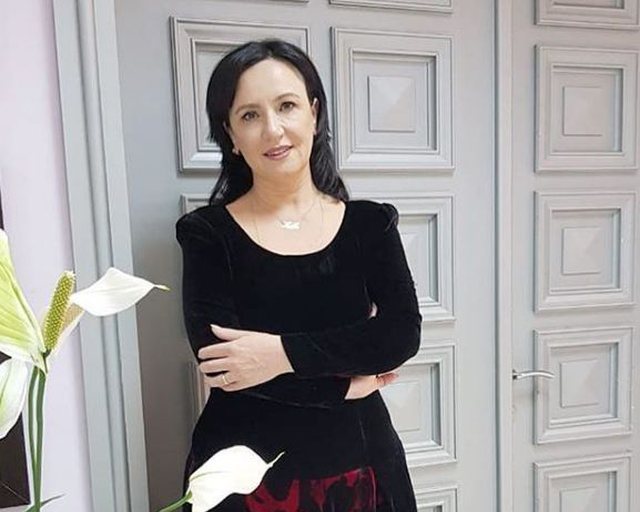
Speech by Linda Rama at the London Global Woman Summit